Tracking Giants
New Technology Helps Protect Elephant Bulls
Saving the Survivors has recently supported the re-collaring of two elephant bulls — one subadult and one mature — using state-of-the-art Rouxcel tracking collars.
The intervention forms part of our ongoing commitment to combining veterinary expertise, field conservation and innovative technology to better understand and protect Africa’s wildlife.
The Rouxcel collars, sponsored by Saving the Survivors, represent a significant advancement in wildlife tracking. Designed for long-term use in the field, the collars use highly efficient power-management systems and an integrated solar panel, allowing them to recharge continuously while the elephants move through their natural habitat.
This technology enables the collars to transmit location data every 15 minutes while maintaining exceptional battery longevity, providing conservation teams with a detailed and reliable picture of each elephant’s movements over time.
More Than a Dot on a Map
Tracking an elephant is about far more than simply knowing where it is.
The information collected by these collars can help conservationists understand how elephants use the landscape, where they travel at different times of the year, which routes they use to move between habitats and where they may come into closer contact with people.
Over time, this detailed movement data can reveal important migration corridors, preferred habitats and areas where human-elephant conflict may be more likely to occur.
This knowledge can then be used to support informed conservation and management decisions, helping teams on the ground respond more effectively to changing conditions and potential threats.
A Carefully Managed Veterinary Intervention
Fitting or replacing a tracking collar requires a carefully coordinated veterinary intervention.
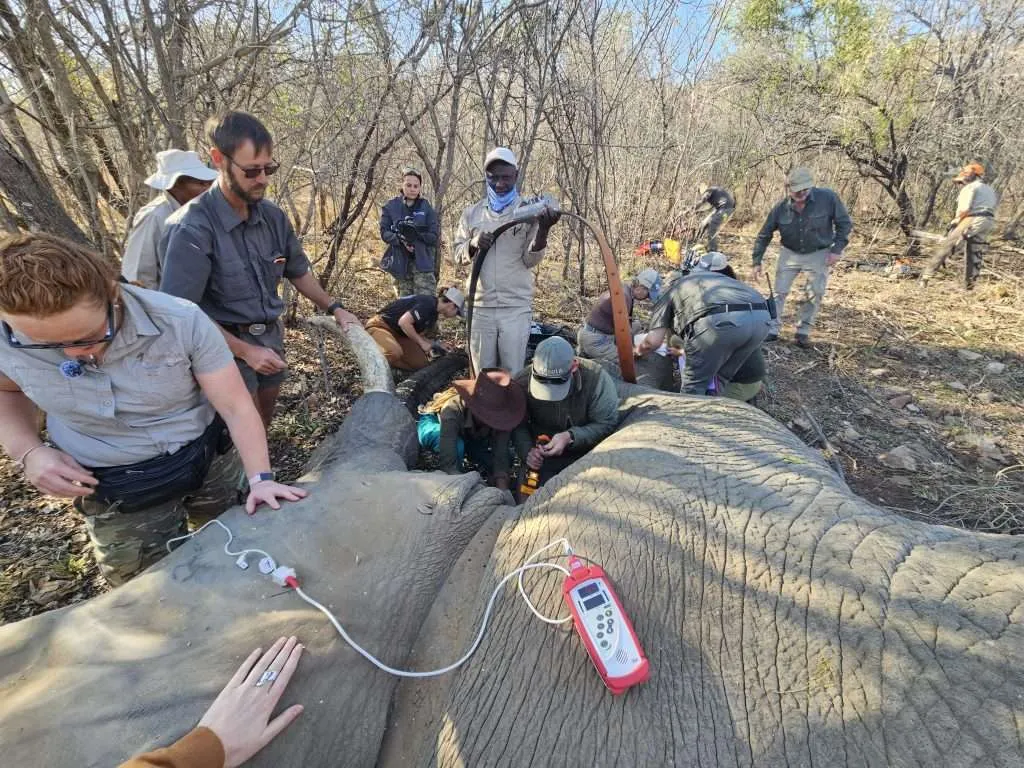
The elephants must be safely immobilised so that the team can work quickly and efficiently, while continually monitoring the animal throughout the procedure. Once the new collar is fitted and all necessary checks have been completed, the elephant is able to recover and return to the landscape carrying technology that will help protect and study it for years to come.
The photographs from this intervention offer a glimpse behind the scenes at the work involved in safely fitting these collars and ensuring that these magnificent animals can continue to be monitored.
Technology Supporting Conservation
Advances in wildlife-tracking technology are becoming an increasingly important part of modern conservation.
When combined with experienced field teams, veterinary care and long-term monitoring, tools such as these collars can provide information that would otherwise be extremely difficult to obtain.
For Saving the Survivors, this is an important part of our wider approach to conservation. Our involvement does not end when an animal gets back on its feet and walks away from an intervention.
By supporting monitoring, research and long-term protection, we can help build a deeper understanding of the animals we work to protect and the challenges they face.
These two elephants can now continue their journeys while providing invaluable information that will help conservation teams better understand their movements and protect them into the future.
Protect. Monitor. Understand. Conserve.


MORE BUSH JOURNAL
Tracking Giants
New Technology Helps Protect Elephant Bulls Saving the Survivors has recently supported the re-collaring of two elephant bulls — one subadult and one mature — using state-of-the-art Rouxcel tracking collars. The intervention forms part of our ongoing commitment to combining veterinary expertise, field conservation and innovative technology to better understand and protect Africa’s wildlife. The … Continued

World Elephant Day 2026
Protecting Africa’s Gentle Giants Today, on World Elephant Day, Saving the Survivors celebrates one of the most extraordinary and iconic animals to walk our planet — the elephant. Elephants have always held a very special place in the work of Saving the Survivors. Over the years, our veterinary teams have worked with countless elephants across … Continued

Technology Helping Pangolins Thrive in the Wild
Every successful wildlife release marks the beginning of a new chapter, but ensuring an animal continues to thrive in the wild requires ongoing monitoring. For species as vulnerable as the pangolin, every check-up provides invaluable insight into the success of their rehabilitation and release. Recently, the Saving The Survivors team returned to the field to … Continued

Strengthening the Future of White Rhinos Through Genetic Conservation
Saving the Survivors, in partnership with the Veterinary Conservation Coalition (VCC), has successfully completed the translocation of several White rhino cows to a South African reserve where no new genetics had been introduced for more than 20 years. Although moving rhinos is a complex and carefully planned operation, this project was about much more than … Continued

Innocent Victim:
White Rhino Saved After Devastating Snare Injury Every snare tells a tragic story. Not because it catches the animal it was intended for, but because it so often catches those it was never meant to. This adult White rhinoceros cow became one of those innocent victims. When our veterinary team located her, she was suffering … Continued

Nature's Medicine at Work
A Remarkable Rhino Recovery A few weeks ago, we shared the story of a Southern White Rhino mother suffering from a significant wound to her hindquarters, most likely caused by the horn of an overenthusiastic bull. At the time, the injury was extensive and vulnerable to infection. In the harsh conditions of the African bush, … Continued

Big Ben's Battle Scars:
An Unusual Treatment for an Extraordinary Patient Life for a dominant bull rhino is rarely peaceful. For Big Ben, one of the area’s largest and most powerful white rhinos, a recent territorial dispute left him with a significant facial wound. Like many mature bulls, Big Ben regularly encounters rivals competing for territory, breeding rights, and … Continued

A Rhino, An Elephant and a Race Against Time
At Saving the Survivors, no two wildlife interventions are ever the same. Recently, our veterinary team was called to assist a White Rhino cow suffering from a severely damaged horn. While injuries to horns can appear straightforward at first glance, they often require careful assessment and treatment to prevent complications and ensure the animal’s long-term … Continued

Monitoring One of Africa’s Most Vulnerable Predators
Saving the Survivors recently carried out an important conservation intervention involving an adult male cheetah living on a protected property where a coalition of males was successfully introduced by Saving the Survivors and the Veterinary Conservation Coalition in 2025. As part of our ongoing monitoring and conservation work, the cheetah was carefully immobilised by our … Continued

Hope Continues Her Frontline Mission Protecting Wildlife
At Saving the Survivors, every success story is built on the support of people who believe wildlife is worth protecting. Hope, one of our anti-poaching K9s, is a perfect example of what that support can achieve. Thanks to the generosity of our supporters, Hope was purchased, trained, and deployed to help protect wildlife on the … Continued

A Mother’s Strength in the African Bush
Out in the African bush, survival is never easy. Every day brings new challenges, and even the strongest animals can suffer painful injuries in the wild. Recently, the veterinary team from Saving the Survivors responded to help a Southern White Rhino cow found with a significant wound to her back leg, most likely caused by … Continued

Eight Years On:
A Story of Strength, Survival, and Hope Eight years ago, a magnificent adult bull elephant suffered a fracture to his left front limb — an injury that could easily have marked the end of his journey. But this elephant endured. Recently, our Founder and Head Veterinarian, Dr Johan Marais, returned with the Saving the Survivors … Continued

