Hope The Poaching Survivor’s Story
It is still hard to believe that our beloved Hope is no longer with us, especially since she left so suddenly and unexpectedly. But her spirit continues to live on, she remains the voice for other Rhino poaching survivors and she will forever Help Other People Evolve.
This is her story…
End of April 2015:
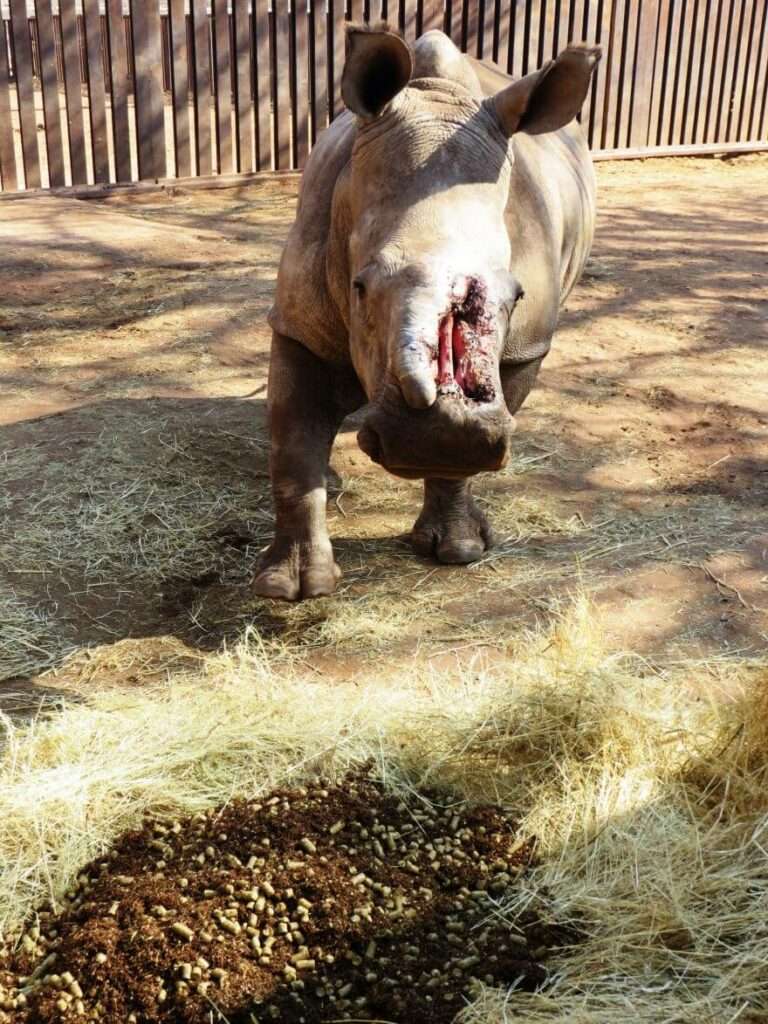
The approximately six year old Rhino was first darted and then attacked by poachers who hacked off both her horns and left her for dead. Badly mutilated, she wondered around and hid in the bushes for four days and five nights.
Beginning of May 2015:
When eventually found, part of the rhino cow’s face, nasal passages and sinus cavities were exposed while several bones were also severely fractured. It was one of the most brutal poaching attacks since the rhino poaching scourge began. However, a decision was made by veterinary experts that the Rhino, who had since been named Hope, could be saved and she was moved to the rehabilitation centre at the Shamwari Game Reserve near Port Elizabeth.
May 2015:
Hope’s first surgery took place and Saving The Survivors (STS) was called in to assist with the treatment on her face. Dr Johan Marais, CEO of STS, described the 50cm by 30 cm wound as “one of the worst injuries” that he had ever worked on. The wound was cleaned, maggots removed and an artificial cast was put in place for protection. This process continued during the next couple of weeks/months.
June 2015:
A third procedure, taking over two hours, is performed on Hope. During the second procedure, the first shield was removed as it had come loose because she rubbed it off against the boma’s fence. During the third operation, the bottom part of the shield had to be drilled on because of insufficient bone structure to keep it in place properly. Radiographs had showed that the poachers removed too much bone for the required attachment points. More dead tissue and bone was further removed. A mould was also made of the shield to cut down on future procedure time. It was anticipated that Hope’s recovery would take at least a year and a half.
June 2015:
Hope received her fourth treatment, again over two hours. She was given injections of antibiotics, pain relief and anti inflammatories as well as an anti-parasite treatment. More maggots were removed and the wound was flushed. A clean new cast was then screwed on.
July 2015:
A fifth procedure is performed on Hope. Although the large wound had healed really well during the previous couple of weeks, a new type of protective shield had to be put in place once again as the previous one had come off. This new shield was more elastic but it was a challenge (taking almost three hours) to put it in place because of almost no bone left to attach it to. The challenge remained to keep her shield in place so that she was not vulnerable to infection and disease.
August 2015:
Some time had passed since the last procedure. Hope’s wound was being reassessed with a new protective shield out of elephant hide, thought to be strong but still supple enough, to be applied. The feisty rhino once again removed the previous protection of her wound. The Saving the Survivors team used stainless steel orthopaedic wire to stitch the elephant hide (obtained from an animal that died from natural causes) in place. This after kudu skin (wire tore through it) and hippo skin (too thick) were tried unsuccessfully. After the procedure, Hope was moved to a new enclosure at Shamwari.
March 2016:
It is decided to move Hope to a wildlife holding facility just outside Bela Bela in the Limpopo Province. Here she will be nearer to the STS team and the specialist treatment needed for recovery. The challenge remained to close the gaping wound that is not healing on its own. This remained a risk for infection due to maggot infestations among other things.
May 2016:
Survivor Hope has had at least 16 surgical procedures since she was attacked by poachers just over a year ago. And she had remained as big a fighter as ever. It was estimated that the wound had reduced by as much as two thirds. This is thanks to innovative procedures carried out in the past 12 months. The latest one was the Abdominal Re-approximation Anchor System (ABRA), which are specially made elastic bands from a Canadian company, Southmedic. The bands, stretched across Hope’s gaping facial wound, are designed for human patients who had received abdominal surgery and acted like shoelaces, stretching skin on both sides closer together.
June 2016:
Hope’s wound had closed even more since the ABRA strips were applied a month ago. But yet again she remained annoyed by the dressings on her face and kept rubbing them off against the boma’s fence. The STS team however didn’t give up and applied a glue-on version of ABRA as it was thought to be less irritating. A plan was also put in place to move Hope to a bigger enclosure with orphaned Rhino calves and more natural surroundings.
September 2016:
Hope remained in excellent condition, eating and drinking well, and her wound continued to heal. It even seemed that a small little back horn had started to grow, although this may have to be removed at some point. She did however seemed to be agitated at times when humans came too close to the boma fence. The treatment on her wound continued and various methods looked at and investigated to secure a permanent covering.
13 November 2016:
The day that all hoped would never come… Saving The Survivors shared the devastating news that our beloved white rhino cow, Hope, passed away. She was found in the late afternoon without life in her boma.
Dr Marais from STS was himself present at the post mortem. The entire small intestine was severely affected, showing signs of haemorrhage and discolouration. Looking at the injury, the course of the disease was extremely quickly. So much so that she must have died within an hour or two maximum. This is also confirmed by the fact that she was seen on Sunday afternoon with no signs of being sick, and then was found dead late afternoon.
Said Dr Marais at the time:
“Hope has won over hearts of people all over the world. She was a feisty and fabulous rhino that never gave up her fighting spirit. She contributed immensely to science, by teaching veterinarians how to heal her face. Other Rhinos may benefit from this new info. This is already happening with a Rhino called Seha, which is treated by Saving the Survivors. Seha is suffering from exactly the same injury as Hope. His wound healing is already much improved, due to knowledge that was gained from treating Hope.
“Hope was featured in hundreds of print publications as well as on all the major news channels and networks worldwide. By doing so she created massive awareness on the Rhino poaching crisis, across the globe. This is something that cannot be bought or measured in monetary terms.
I am incredibly privileged to have been able to work on such an amazing animal.”
How can I support Saving The Survivors?
You can help us by donating today to support vulnerable African wildlife. Donate here.
You can also support us by following us on facebook and sharing our stories to give these vulnerable animals a voice.


MORE BUSH JOURNAL
Tracking Giants
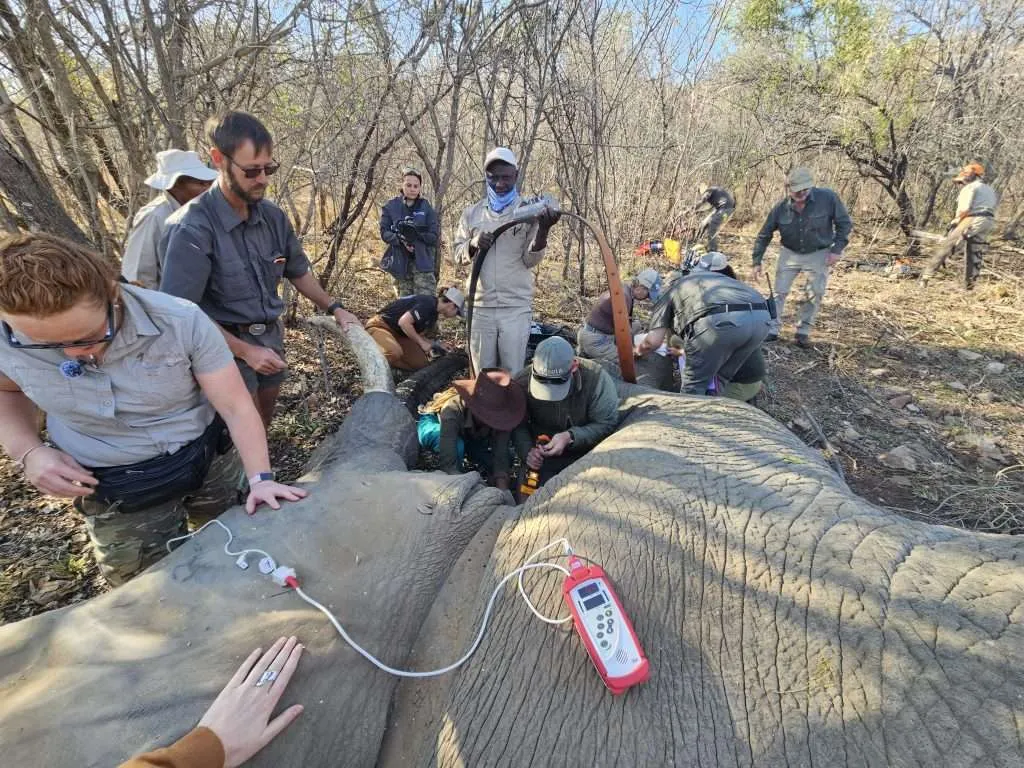
New Technology Helps Protect Elephant Bulls Saving the Survivors has recently supported the re-collaring of two elephant bulls — one subadult and one mature — using state-of-the-art Rouxcel tracking collars. The intervention forms part of our ongoing commitment to combining veterinary expertise, field conservation and innovative technology to better understand and protect Africa’s wildlife. The … Continued

World Elephant Day 2026
Protecting Africa’s Gentle Giants Today, on World Elephant Day, Saving the Survivors celebrates one of the most extraordinary and iconic animals to walk our planet — the elephant. Elephants have always held a very special place in the work of Saving the Survivors. Over the years, our veterinary teams have worked with countless elephants across … Continued

Technology Helping Pangolins Thrive in the Wild
Every successful wildlife release marks the beginning of a new chapter, but ensuring an animal continues to thrive in the wild requires ongoing monitoring. For species as vulnerable as the pangolin, every check-up provides invaluable insight into the success of their rehabilitation and release. Recently, the Saving The Survivors team returned to the field to … Continued

Strengthening the Future of White Rhinos Through Genetic Conservation
Saving the Survivors, in partnership with the Veterinary Conservation Coalition (VCC), has successfully completed the translocation of several White rhino cows to a South African reserve where no new genetics had been introduced for more than 20 years. Although moving rhinos is a complex and carefully planned operation, this project was about much more than … Continued

Innocent Victim:
White Rhino Saved After Devastating Snare Injury Every snare tells a tragic story. Not because it catches the animal it was intended for, but because it so often catches those it was never meant to. This adult White rhinoceros cow became one of those innocent victims. When our veterinary team located her, she was suffering … Continued

Nature's Medicine at Work
A Remarkable Rhino Recovery A few weeks ago, we shared the story of a Southern White Rhino mother suffering from a significant wound to her hindquarters, most likely caused by the horn of an overenthusiastic bull. At the time, the injury was extensive and vulnerable to infection. In the harsh conditions of the African bush, … Continued

Big Ben's Battle Scars:
An Unusual Treatment for an Extraordinary Patient Life for a dominant bull rhino is rarely peaceful. For Big Ben, one of the area’s largest and most powerful white rhinos, a recent territorial dispute left him with a significant facial wound. Like many mature bulls, Big Ben regularly encounters rivals competing for territory, breeding rights, and … Continued

A Rhino, An Elephant and a Race Against Time
At Saving the Survivors, no two wildlife interventions are ever the same. Recently, our veterinary team was called to assist a White Rhino cow suffering from a severely damaged horn. While injuries to horns can appear straightforward at first glance, they often require careful assessment and treatment to prevent complications and ensure the animal’s long-term … Continued

Monitoring One of Africa’s Most Vulnerable Predators
Saving the Survivors recently carried out an important conservation intervention involving an adult male cheetah living on a protected property where a coalition of males was successfully introduced by Saving the Survivors and the Veterinary Conservation Coalition in 2025. As part of our ongoing monitoring and conservation work, the cheetah was carefully immobilised by our … Continued

Hope Continues Her Frontline Mission Protecting Wildlife
At Saving the Survivors, every success story is built on the support of people who believe wildlife is worth protecting. Hope, one of our anti-poaching K9s, is a perfect example of what that support can achieve. Thanks to the generosity of our supporters, Hope was purchased, trained, and deployed to help protect wildlife on the … Continued

A Mother’s Strength in the African Bush
Out in the African bush, survival is never easy. Every day brings new challenges, and even the strongest animals can suffer painful injuries in the wild. Recently, the veterinary team from Saving the Survivors responded to help a Southern White Rhino cow found with a significant wound to her back leg, most likely caused by … Continued

Eight Years On:
A Story of Strength, Survival, and Hope Eight years ago, a magnificent adult bull elephant suffered a fracture to his left front limb — an injury that could easily have marked the end of his journey. But this elephant endured. Recently, our Founder and Head Veterinarian, Dr Johan Marais, returned with the Saving the Survivors … Continued

