
Landmark Victory in Rhino Poaching Case
Highlights Collaborative Success in Wildlife Protection
A significant step forward in the fight against wildlife crime was achieved last week when Congolese poacher Francis Kipampa, a high-ranking figure in a Rhino horn trafficking syndicate, was sentenced to 18 years in prison by the Middleburg Regional Court in South Africa.
This groundbreaking case underscores the importance of collaboration between government agencies, non-governmental organisations (NGOs), and the private sector in combatting organised wildlife crime.
Unveiling the Network
Kipampa’s conviction was the result of a multi-year investigation, codenamed Project Blood Orange, which leveraged financial forensics to dismantle a sprawling criminal network. This investigation was spearheaded by South Africa’s Directorate for Priority Crime Investigations (DPCI) and supported by law enforcement, financial experts, and conservation NGOs like Save the Rhino.
The investigation gained traction after the 2020 assassination of Lt-Col Leroy Bruwer, a dedicated officer who had been tracking the activities of a notorious poaching syndicate. Despite setbacks, evidence collected during the operation—including DNA samples found in Kipampa’s home—proved instrumental in securing his conviction.
Kipampa was charged with trafficking Rhino horns, laundering R1,000,000 in illicit proceeds, and immigration violations. His guilty plea and the subsequent sentence mark a milestone in the fight against wildlife crime, as the justice system demonstrated zero tolerance for poaching and its associated activities.
The Role of Corruption
The case also shed light on systemic challenges, including corruption among rangers and locals who colluded with poachers. According to reports, some rangers accepted bribes to provide critical information, enabling poachers to evade detection. Dr. Dion George, South Africa’s Minister of Forestry, Fisheries, and the Environment, acknowledged these challenges while emphasising that such individuals represent a small fraction of the workforce.
“South Africans should continue to support the rangers who put their lives at risk and remain committed to protecting our country’s vulnerable wildlife,” said Dr. George.
Tackling corruption requires strengthening oversight mechanisms, providing adequate training and resources for rangers, and fostering public trust in the integrity of conservation efforts.
Collaboration: A Winning Formula
The success of Project Blood Orange highlights the transformative power of collaboration. Save the Rhino played a crucial role by sourcing funding from diverse partners, including the UK Government’s Illegal Wildlife Trade Challenge Fund, private reserves, and philanthropic organisations. These resources supported the investigation’s financial forensic research, which was pivotal in uncovering the syndicate’s illicit activities.
“By following the money, we’ve exposed and disrupted illegal activity. This is a game-changer for tackling organised wildlife crime,” said Cathy Dean, Save the Rhino’s Grants Lead.
This case demonstrates that sustained partnerships between state and non-state actors can yield tangible results, making a compelling argument for continued investment in conservation initiatives.
Why Supporting Conservation Charities Matters
Charities like Save the Rhino not only fund investigations but also drive innovation in wildlife protection, from supporting anti-poaching units to improving ranger welfare. Their work ensures that endangered species like Rhinos have a fighting chance against extinction.
Dr. George’s commitment to a zero-tolerance approach toward poaching and the involvement of NGOs in efforts like Project Blood Orange prove that supporting conservation organisations is a powerful way to protect wildlife.
Together, with the help of donors and dedicated partners, we can turn the tide against poaching, ensuring that Rhinos and other iconic species continue to thrive in the wild.


MORE BUSH JOURNAL
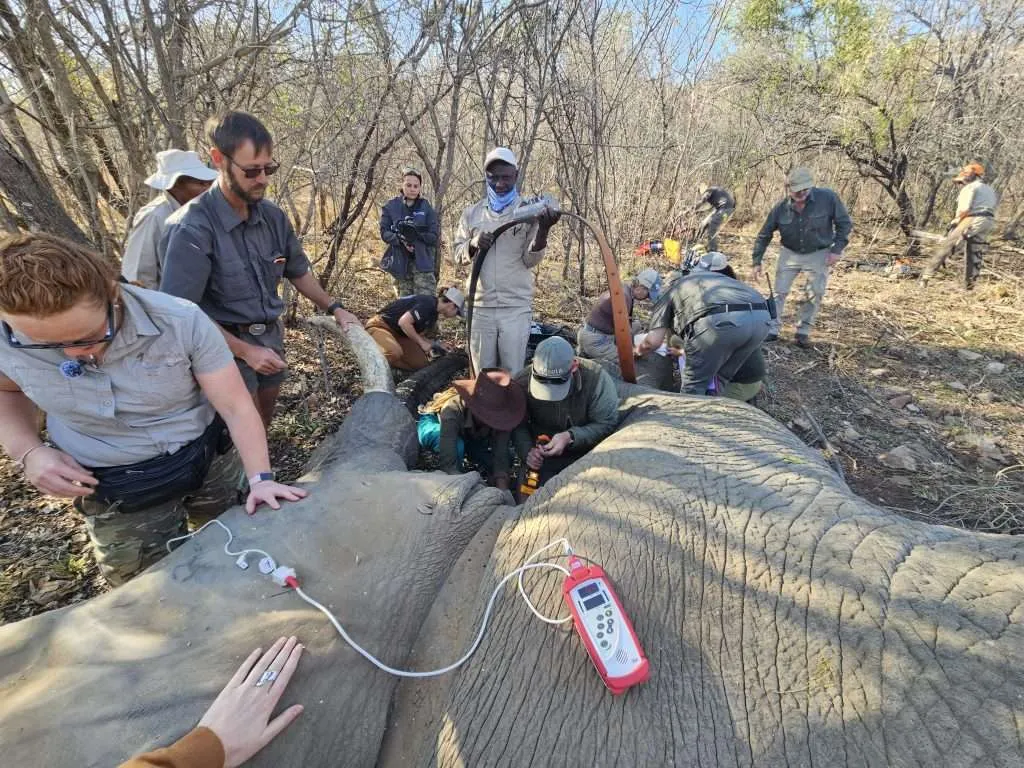
Tracking Giants
New Technology Helps Protect Elephant Bulls Saving the Survivors has recently supported the re-collaring of two elephant bulls — one subadult and one mature — using state-of-the-art Rouxcel tracking collars. The intervention forms part of our ongoing commitment to combining veterinary expertise, field conservation and innovative technology to better understand and protect Africa’s wildlife. The … Continued

World Elephant Day 2026
Protecting Africa’s Gentle Giants Today, on World Elephant Day, Saving the Survivors celebrates one of the most extraordinary and iconic animals to walk our planet — the elephant. Elephants have always held a very special place in the work of Saving the Survivors. Over the years, our veterinary teams have worked with countless elephants across … Continued

Technology Helping Pangolins Thrive in the Wild
Every successful wildlife release marks the beginning of a new chapter, but ensuring an animal continues to thrive in the wild requires ongoing monitoring. For species as vulnerable as the pangolin, every check-up provides invaluable insight into the success of their rehabilitation and release. Recently, the Saving The Survivors team returned to the field to … Continued

Strengthening the Future of White Rhinos Through Genetic Conservation
Saving the Survivors, in partnership with the Veterinary Conservation Coalition (VCC), has successfully completed the translocation of several White rhino cows to a South African reserve where no new genetics had been introduced for more than 20 years. Although moving rhinos is a complex and carefully planned operation, this project was about much more than … Continued

Innocent Victim:
White Rhino Saved After Devastating Snare Injury Every snare tells a tragic story. Not because it catches the animal it was intended for, but because it so often catches those it was never meant to. This adult White rhinoceros cow became one of those innocent victims. When our veterinary team located her, she was suffering … Continued

Nature's Medicine at Work
A Remarkable Rhino Recovery A few weeks ago, we shared the story of a Southern White Rhino mother suffering from a significant wound to her hindquarters, most likely caused by the horn of an overenthusiastic bull. At the time, the injury was extensive and vulnerable to infection. In the harsh conditions of the African bush, … Continued

Big Ben's Battle Scars:
An Unusual Treatment for an Extraordinary Patient Life for a dominant bull rhino is rarely peaceful. For Big Ben, one of the area’s largest and most powerful white rhinos, a recent territorial dispute left him with a significant facial wound. Like many mature bulls, Big Ben regularly encounters rivals competing for territory, breeding rights, and … Continued

A Rhino, An Elephant and a Race Against Time
At Saving the Survivors, no two wildlife interventions are ever the same. Recently, our veterinary team was called to assist a White Rhino cow suffering from a severely damaged horn. While injuries to horns can appear straightforward at first glance, they often require careful assessment and treatment to prevent complications and ensure the animal’s long-term … Continued

Monitoring One of Africa’s Most Vulnerable Predators
Saving the Survivors recently carried out an important conservation intervention involving an adult male cheetah living on a protected property where a coalition of males was successfully introduced by Saving the Survivors and the Veterinary Conservation Coalition in 2025. As part of our ongoing monitoring and conservation work, the cheetah was carefully immobilised by our … Continued

Hope Continues Her Frontline Mission Protecting Wildlife
At Saving the Survivors, every success story is built on the support of people who believe wildlife is worth protecting. Hope, one of our anti-poaching K9s, is a perfect example of what that support can achieve. Thanks to the generosity of our supporters, Hope was purchased, trained, and deployed to help protect wildlife on the … Continued

A Mother’s Strength in the African Bush
Out in the African bush, survival is never easy. Every day brings new challenges, and even the strongest animals can suffer painful injuries in the wild. Recently, the veterinary team from Saving the Survivors responded to help a Southern White Rhino cow found with a significant wound to her back leg, most likely caused by … Continued

Eight Years On:
A Story of Strength, Survival, and Hope Eight years ago, a magnificent adult bull elephant suffered a fracture to his left front limb — an injury that could easily have marked the end of his journey. But this elephant endured. Recently, our Founder and Head Veterinarian, Dr Johan Marais, returned with the Saving the Survivors … Continued

